For more than three decades, Assyrians in northern Iraq have raised concerns over unresolved land disputes and inconsistent enforcement of court rulings. On 6 July 2026, hundreds gathered peacefully outside the Duhok Governorate building to demand the same thing they’ve asked for since the 1990s: that lawful court decisions actually be enforced.
ADBA’s new policy paper, Justice Delayed, Democracy Denied: Protecting Iraq’s Indigenous Assyrians Through the Rule of Law, argues that this is not simply a minority-rights issue — it is a test of Iraq’s commitment to constitutional governance and the rule of law.
The scale of the issue
- Fewer than 150,000 Christians remain in Iraq today, down from roughly 1.5 million before 2003
- More than 130 documented village and farmland seizures across the Kurdistan Region
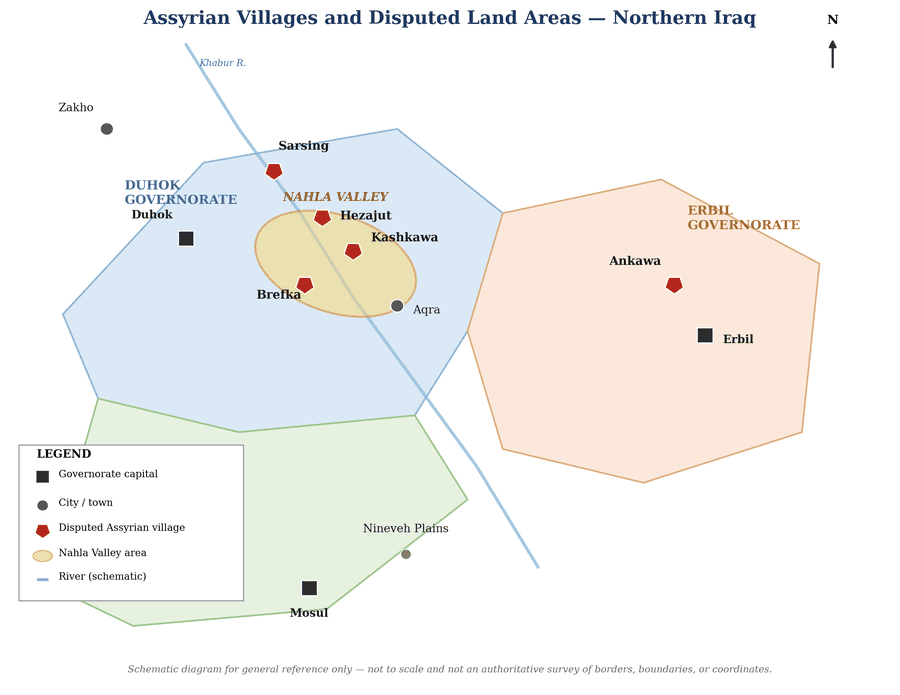
- 67 unresolved land-dispute cases in the Nahla Valley alone as of 2023
One case illustrates the pattern well. In the village of Kashkawa, in the Nahla Valley, Assyrian residents won a favorable court ruling in 2016 after years of litigation — yet as of 2026, that ruling still has not been enforced, and residents report the disputed land has been cultivated again by the original encroachers. The obstacle was never a lack of a legal decision. It was the absence of enforcement.
A test now facing the Iraqi government
Only days after the Duhok demonstration, Iraqi Prime Minister Ali Falih al-Zaidi publicly invited Christians who left Iraq to return, calling it a “national priority” and pledging land-plot eligibility and investment support. The announcement was welcomed by church leaders — but independent Iraqi journalists have already questioned whether incentives alone can succeed without addressing the underlying rule-of-law failures that caused emigration in the first place.
ADBA’s paper argues this is precisely the point: if the Government of Iraq wants displaced Assyrians and other Christians to return, it must also guarantee that returning families can safely reclaim their homes, farms, and ancestral lands. Inviting people back while leaving land disputes unresolved sends a contradictory message.
What the paper recommends
The paper offers specific, actionable recommendations for the Government of Iraq, the Kurdistan Regional Government, Assyrian civic organizations, the United States, and the international community — including an independent minority-property review commission, public tracking of court judgments, and international observation of longstanding unresolved cases.

